
.png?width=50)
Whether you're organising a company party, industry-wide convention, or community gathering, planning sustainable events in Westminster is a great way to show your customers and community you are serious about the environment.
In this article, we will show you how to make your event as sustainable as possible focusing on waste management in partnership with Westminster City Council and it’s sustainable events guide.
This is particularly important when research has shown conference participants can generate on average 1.89 kg of waste and more than 176 kg of CO2 emissions per day, according to calculations by event agency MeetGreen.
Reduce waste at your event
Events can generate large amounts of waste through catering, packaging, paper waste, and promotional materials. A green event is often also a zero-waste event. To reduce waste, implement the waste hierarchy:
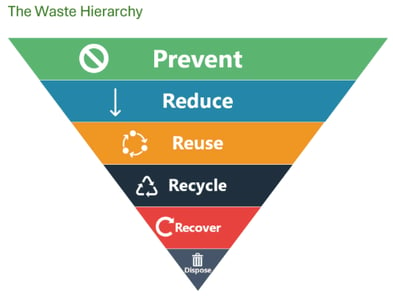
- Prevent - Avoid waste before it is created. For example, ask attendees to register digitally and send all event communications online rather than printing invitations or programmes.
- Reduce - Minimise the amount of waste produced. For example, only order the catering and materials you need by collecting attendee numbers and dietary requirements in advance.
- Reuse - Use items more than once. For example, opt for reusable cups, crockery and cutlery rather than single-use alternatives, and collect name badges at the end of the event for future use.
- Recycle - Separate and recycle unavoidable waste. For example, provide clearly labelled recycling bins. At CWS we can provide:
- Mixed recycling
- Paper and cardboard recycling
- Glass recycling
- Food waste recycling
- Recover - Extract value from waste that cannot be recycled. For example, work with CWS to ensure any remaining waste is converted into energy rather than sent to landfill by using our general waste service.

Distribute sustainable promotional items/gifts
Anyone who visited a trade fair or a specialist congress a few years ago often came back with a whole bag full of pens, key rings and other promotional gifts – many of them made of plastic or wrapped in plastic.
Most of it probably ended up in the bin after a short time. There are now alternatives that are not only more sustainable but also make a lasting impression, such as cork pens, wooden pencils or small bags with flower seeds.
This may be a little more expensive, but it is more likely that it will be used and it is more likely to be remembered by the event participants than the 100th plastic pen.
Remove single-use plastics from events
This reduces the unnecessary use of resources whilst supporting the existing 2023 single-use plastics ban. Learn more about alternatives and how we can help with this in our ‘Single-use plastics ban: Two years on’ blog.
Reduce paper use
Admission tickets, programme booklets and advertising flyers can all add up during events. Consider whether you can make these things digital, such as making documents easy for guests to download, providing QR codes or maybe even creating an event app.
If you cannot avoid printing documents, use recycled paper and print sparingly. Don't forget to recycle all your paper after the event using a paper and cardboard recycling service.

Decorations
Buy decorations that you can reuse for the next corporate event, promoting reuse as well as saving your long term costs. Collect name tags at the end of the event and use them again next time. Offer drinks in reusable cups or bottles. Roller banners can be returned, exchanged, or upgraded.
Recycling
When waste is unavoidable, provide recycling bins at all events for mixed recycling, paper and cardboard, and glass. Ensure recycling facilities are easily accessible to visitors, using clear labelling and signage on waste separation. It's important that recycling bins are paired with general and food waste bins to avoid contamination.
Download our free recycling guide
Donate leftover food
Professional caterers can estimate how much food is needed for a predetermined number of people, so there shouldn't be too many leftovers. Nevertheless, you can ask the participants about their likes and dislikes in advance to prevent an excess of individual dishes.
Design a plan to deal with surplus food before the event by donating leftover food to local community groups: City Harvest, The Felix Project, Trussel Trust Food Bank, Too Good to Go, or the Olio app. Doing this not only prevents waste, but it also is a great opportunity for a good news story featuring your business. For success, ensure a nominated person uploads items and arranges collection on the day.
Download our free food waste guide
Key Westminster contact: ReduceReuseRecycle@westminster.gov.uk
Learn more about sustainability
To learn more about how you can make your next event more sustainable, download our free sustainability guide and use Westminster City Council’s comprehensive Sustainable Events Checklist (p16-17) to ensure you've covered all aspects of sustainable event planning.
For more information or support in planning your sustainable event, contact: ReduceReuseRecycle@westminster.gov.uk


